Thursday, August 18, 2011

Bickering Beagles and Bedtime...

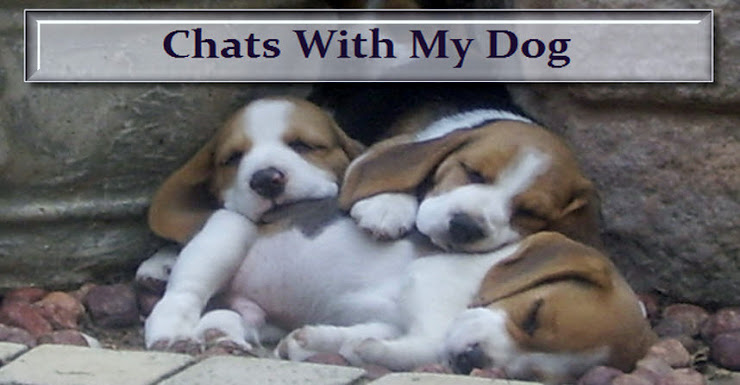
My dogs bicker and growl at each other every night over who has the right to sleep where in their bed. I know the warning signs when I hear a low whining growl from Jamie or a loud ear blasting bark from Jemma.

Usually one has hogged all the blankets leaving the other with nothing or one has settled down and gets very irritated by the late arrival of the other who messes up the sleeping arrangements. Otherwise one has taken over the whole bed and will not make room for the other.

Jemma loudly broadcasts her dissatisfaction by rushing around the garden barking madly and waking up all the neighbours. This is usually perfectly timed to coincide with the moment I have chosen to take a relaxing bath. Or she comes and scratches at the bath door disturbing my meditation. I nearly trip over her when I am finally forced to surrender my "me time" and leave the bathroom.

This means that instead of diving under the duvet, all warm and cosy from my hot bath, I have to venture into the cold and sort out the the bickering children. I have to remake the bedding which is often scattered all over the place during the altercation, allocate blankets fairly to each dog and tuck them into bed (literally). They usually settle down after this.

But sometimes someone decides to go for a pee and the bickering starts all over again. By this time I am usually on my way to dream land and my response is "Oh for goodness sake, let them sort it out!". I mean really, how spoilt is that - tucking my beagles into bed every night!
Next I'll be reading them bed time stories.

Wednesday, July 13, 2011

Wounded in the line of Dog Duty...

I remember our canine behaviour lecturer saying that if one wants to work with dogs, a tetanus vaccination is a prerequisite. I found out why this weekend.

I am now learning how to work with adolescent and adult dogs - a whole different ball game from puppies. In these adult classes one gets a real mix of dogs from different backgrounds. Some dogs are well socialised (often owners who attended puppy classes and want to continue keeping their dogs stimulated and challenged through training).
Then there are those dogs that have not been socialised and have now become troublesome teenagers, so their owners want to "fix" the dog's bad behaviour. (Why oh why doesn't everyone who gets a puppy go to puppy socialisation classes? It would save them and their dogs so many headaches.) And finally there are the adopted or rescue dogs who often have problems but little is know about their past. Betty was one such dog.

She was a small mixed breed (with a bit of Staffie) who barked madly and rushed furiously at every dog in the class with bared teeth. During training, my hand accidentally had an encounter with Betty's teeth. It was not deliberate on Betty's part. It was my body part that got in the way. The bite was minor and after applying a plaster, I decided to tackle Betty's problem again.

Betty was obviously in a state of stress. She was interpreting her environment especially the other dogs as a hazard and her natural reaction was to go into hazard avoidance mode. Dogs can choose either to flee, freeze, faint, fidget or fight. Well, Betty was on a leash in a situation she could not escape, so she chose to fight. What appeared as aggression towards other dogs was, in my opinion, Betty actually saying "Hey! I am afraid of you other dogs, so don't come near me or else!!".

Other physical signs of stress are tension in body posture, staring eyes, a tight muzzle, uneven fast panting, lip licking, whining, a very dry mouth or excessive salivating, cold paws and a sudden outbreak of dandruff on the dog's fur. Betty had many of these symptoms.

When a dog is stressed its ability to learn is considerably reduced. So both Betty and her owner were getting extremely frustrated because she was in fear mode and not able to learn anything.

We decided to try some of the basic touches from a method known as Tellington Touch. This works like magic when one wants to calm and build confidence in animals! We used long, gentle, calming strokes along Betty's body, around her hind quarters, tail and her ears where she held tension. We also used touch as a way of praising her because stress often causes a loss of appetite. As a result food no longer works as a motivator or a reward. Every time Betty stopped barking at the other dogs, she got praise the moment she made eye contact with her owner. Focusing on her owner and not the other dogs was the behaviour that was being reinforced.
We then repeated exercises she could easily do like sit, paw and spin and lavishly praised her each time she succeeded. This meant Betty experienced some sense of achievement during the class.

My personal feeling was that the fact that she'd become calmer towards the end of the class was the most important achievement of all. The fact that she was not learning more new tricks like the rest of dogs, was less important. Betty needs to become less stressed and more at ease when exposed to other dogs, people and different situations. Her owners will need a lot of patience to help her achieve this. Hopefully they will hang in there and not give up on Betty.

I was going to ignore the bite. After all it wasn't serious. But since I had never had a tetanus vaccination, one of the instructors advised me not to take any chances. Oh well, if I was going to be working with dogs, it had to be done. So at five o'clock on a Saturday afternoon I schlepped off to the Emergency room of the nearest hospital. Since my case was coded green ( not critical) I had a long wait ahead of me. Whilst sitting in my cubicle I heard some strange stories emanating from the other cubicles. A man fixing his car had dropped the engine on his thumb thoroughly mashing it in the process. In another cubicle a patient was complaining that his gonorrhea symptoms were getting worse...

One and a half hours later, the attending doctor scared the daylights out of me when he began talking about rabies shots ( a series of three) as well as a tetanus shot and antibiotics (A young girl had recently died of rabies and her palm had merely been grazed by the dog).
I assured him that the dog that bit me had been vaccinated and there was no rabies in the area. I would come back for antibiotics if the bite was showing any signs of infection. So we settled on a tetanus vaccination and dressing my hand with antibiotic cream.

The injection was painless, the bite out of my wallet hurt much more.
But hopefully it will be an insurance policy against any pain and aggravation later on.

Wednesday, June 22, 2011

How we found Bernie's hot button...

Bernie the beagle started "hunting" with his sister this season. He is so laid back and sweet natured, he could be a basset.
It did not take long for his sister to start finishing trails. Fast and agile, she has been doing really well. However Bernie, for some reason, was not running.

The first thing we tried was for Bernie's Dad to walk ahead with the team laying the trail in the hope that Bernie would follow him. But no go.
So I gave his owners my training programme that I had used to train my own dogs by imitating the "hunt" on a minor scale in the park.

Mom and Dad did this faithfully and were surprised that Bernie was the one who picked up the trail first and led the way ahead of his sister. Yet when it came to the actually "hunt" Bernie would run for a short while but always returned to his Mom and the group of waiting owners.

Now from what I've learnt about canine behaviour, the trick to motivating your dog to do something (a behaviour) is to find out what is their hot button. A useful guideline is researching what your dog was bred to do. For example, collies love to herd things, huskies love to pull things and retrievers love to fetch things. In the case of beagles, theoretically they love to follow scents and being part of the crowd joining in the excitement of the chase.

But the other thing that one learns about canine behaviour is that every dog is an individual. Broad scale solutions do not necessarily work for every dog because they are not all the same. So the question was what was Bernie's real hot button? What would incentivise him to join in the "hunt"?

His Mom and Dad had resigned themselves to the belief that Bernie was just not a runner. But I know that deep down (like any parent) you do want your dog to excel. The truth of the matter is that a lot of people drop out of the hunt when their dogs do not run and finish trails. This is a great pity for these dogs who are missing out on a fabulous outing in the bush that leaves them satisfied, happy and stimulated.

I was determined to get Bernie to run because it would be great for both him and his parents.
I began to get an inkling of what Bernie's hot button might be.

At the last "hunt" Bernie arrived with his Mom but no Dad. I insisted that Mom walk the line with the hunt master who was laying the trail. I also insisted that Bernie and his sister be separated at the start line. I took charge of Bernie and Jamie and someone else took Jemma and Bernie's sister. So Bernie was now with a stranger and no Mom or Dad at the start line.

The first time I released Bernie at the start, he immediately began searching the waiting group of owners for his parents. The second time, I made sure that Bernie had a clear view of his Mom disappearing with the team laying the trail.

Suddenly Bernie became a new dog ( I will never accuse him of being a laid back Basset again).
He howled and nearly pulled my arms out of their sockets in an attempt to follow his Mom. They were laying a particularly complicated and long trail around the valley. Those 20 minutes waiting for the horn to blow for the start of the race felt very long as Bernie tried every trick in the book to escape after his Mom.

I held my breath when Bernie disappeared this time. He has an orange race bib and I anxiously scanned every dog in orange returning to the waiting group. None of them was Bernie.
When the race was over and we walked to the finishing line to hear the results, the smile on the face of Bernie's Mom said it all. Bernie had finished the line ahead of his sister. There he sat looking adoringly at his mother.

So finally we had worked out what was Bernie's hot button. He is an extremely people orientated dog. Nothing motivates him more than being with his loving owners. Using the same tactic, Bernie successfully finished the next trail. His proud Mom phoned Dad long distance to share the news.

I was chuffed that I had played a small role in helping Bernie run. I had also learnt an interesting lesson about the need to find each individual dog's hot button if you want to motivate them to achieve a desired behaviour. Bernie's big reward was finding the people he loved at the end of the trail.
Let's hope Bernie keeps running!